
Here are some science questions from the Standards for Grades 2-5 to help you test your knowledge of the Next Generation Sunshine State Standards.
The questions are chosen randomly, so this quest will be different each time you reload the page.
* Click here to see only the most recently added questions.
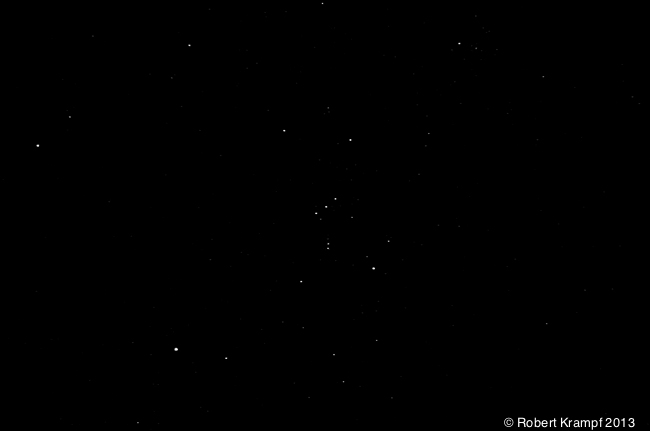
Which of the following is arranged from biggest to smallest?
-
Galaxy, universe, constellation, solar system
-
Universe, galaxy, constellation, solar system
-
Universe, constellation, galaxy, solar system
-
Galaxy, constellation, universe, solar system
Think about it, and when you think you know the answer, then continue.
The answer is 2.
- The universe is the largest, containing all galaxies, constellations, and solar systems.
- Galaxies come next. Each galaxy contains millions of stars.
- Constellations are made up of several individual stars which are often separated by hundreds of lightyears, and only appear close together from our view point on Earth.
- Each star can have one or more planets, forming a solar system.
Click to see which state standards this question tests, and which of my videos, experiments, and other resources support that topic.
Florida
SC.5.E.5.1 Recognize that a galaxy consists of gas, dust, and many stars, including any objects orbiting the stars. Identify our home galaxy as the Milky Way.
| Review Space-2 | practice |
| Review Space-1 | practice |
| Review Space-10 | practice |
SC.8.E.5.3 Distinguish the hierarchical relationships between planets and other astronomical bodies relative to solar system, galaxy, and universe, including distance, size, and composition.
| Making a Scale Model of the Solar System | video, ClosedCaptions |
| Planets and Pennies | video, ClosedCaptions |
| How Far is That Planet? | text page |
| Review Space-3 | practice |
| Review Space-2 | practice |
| Review Space-10 | practice |
Utah
UT.6.IV.1.c Compare the size of the Solar System to the size of the Milky Way galaxy.
| Review Space-2 | practice |
| Review Space-10 | practice |
NGSS
MS-ESS1-3 Analyze and interpret data to determine scale properties of objects in the solar system.
| Making a Scale Model of the Solar System | video, ClosedCaptions |
| Global Science | video, ClosedCaptions |
| Planets and Pennies | video, ClosedCaptions |
| How Far is That Planet? | text page |
| Review Space-3 | practice |
| Review Space-2 | practice |
| Review Space-4 | practice |

The "strings" in a stalk of celery are made up of xylem and phloem. Which part of your body comes closest to serving the same function?
-
Skeleton
No. Your skeleton provides support and protection. In plants, the cell wall provides support and protection. -
Intestines
No. Your intestines allow you to absorb nutrients from your food. Plants make their own food, so they do not need a digestive system. -
Nerves
No. Your nerves carry signals to let the parts of your body communicate. They carry messages for your senses, to move your muscles, etc. Instead of having nerves, plants release chemicals that signal other parts of the plant. -
Blood Vessels
Yes! Your blood vessels carry water and nutrients to different parts of your body. In plants, the xylem is made up of tubes that carry water and some nutrients from the roots upwards to other parts of the plant. The phloem is made up of tubes that carry the sugar produce by photosynthesis to other parts of the plant. While they work in very different ways, your blood vessels serve basically the same function (carrying water and nutrients) as the xylem and phloem in plants.
Click to see which state standards this question tests, and which of my videos, experiments, and other resources support that topic.
Florida
SC.3.L.14.1 Describe structures in plants and their roles in food production, support, water and nutrient transport, and reproduction.
| Heartless Plants | video, ClosedCaptions, checked |
| Pumpkin Guts | video, free, ClosedCaptions, checked |
| Measuring Photosynthesis | video, checked |
| Seed Search | video, ClosedCaptions, checked |
| Orange Slices | video, ClosedCaptions |
| Testing a Leaf for Starch | video, ClosedCaptions |
| Flowers | video, ClosedCaptions |
| Smell the Flowers | text page |
| Review Plants-3 | practice |
| Review Plants-2 | practice |
| Review Plants-5 | practice |
| Review Plants-6 | practice |
| Review Plants-7 | practice |
| Review Plants-8 | practice |
SC.5.L.14.2 Compare and contrast the function of organs and other physical structures of plants and animals, including humans, for example: some animals have skeletons for support — some with internal skeletons others with exoskeletons — while some plants have stems for support.
| Bird Bones | video, free |
| Reading a Skeleton | video, free, checked |
| Orange Slices | video, ClosedCaptions |
| Thoughts on an Exoskeleton | text page, free |
| Review Plants-5 | practice |
| Review Plants-6 | practice |
| Review Plants-7 | practice |
Utah
UT.6.V.1.b Compare characteristics common in observed organisms (e.g., color, movement, appendages, shape) and infer their function (e.g., green color found in organisms that are producers, appendages help movement).
| A Walk in the Park | video, checked |
| Selective Smelling | video, checked |
| Onion Crystals | video |
| Thoughts on an Exoskeleton | text page, free |
| Review Adaptation-3 | practice |
| Review Adaptation-4 | practice |
| Review Plants-5 | practice |
| Review Plants-6 | practice |
| Review Adaptation-5 | practice |
| Review Plants-7 | practice |
| Review Adaptation-6 | practice |
UT.7.IV.2.d Relate the structure of organs to an organism’s ability to survive in a specific environment (e.g., hollow bird bones allow them to fly in air, hollow structure of hair insulates animals from hot or cold, dense root structure allows plants to grow in compact soil, fish fins aid fish in moving in water).
| Hunting with an Umbrella | video, free, ClosedCaptions, Updated |
| Bendable Bones | video, checked |
| Calling a Woodpecker | video, checked |
| Selective Smelling | video, checked |
| Seed Search | video, ClosedCaptions, checked |
| Orange Slices | video, ClosedCaptions |
| Flowers | video, ClosedCaptions |
| Onion Crystals | video |
| Thoughts on an Exoskeleton | text page, free |
| Review Plants-5 | practice |
| Review Plants-6 | practice |
| Review Plants-7 | practice |
NGSS
MS-LS1-1 Conduct an investigation to provide evidence that living things are made of cells; either one cell or many different numbers and types of cells.
| Microscopes: Making a Hay Infusion | video, free, learnalong, checked |
| Microscopes: Making a Wet Mount | video, learnalong, checked |
| Microscopes: Making a Dry Mount | video, learnalong, checked |
| 901 | photo challenge, free |
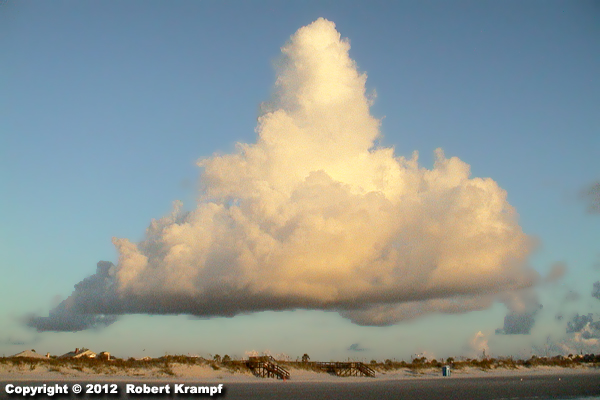
Which of these processes forms the VISIBLE part of a cloud?
-
Evaporation
No. Evaporation changes liquid water into water vapor. Water vapor is an invisible gas, so it is not the visible part of the cloud. -
Condensation
Yes! Condensation changes water vapor into droplets of liquid water to form the cloud. These are just like the tiny water droplets that form fog, letting you see the cloud. -
Precipitation
No. Precipitation can fall from a cloud, but it is not the process that forms the cloud. -
Convection
No. Convection carries the water vapor upwards so it can cool and condense, but condensation is what forms the visible part of the cloud.
Click to see which state standards this question tests, and which of my videos, experiments, and other resources support that topic.
Florida
SC.3.P.9.1 Describe the changes water undergoes when it changes state through heating and cooling by using familiar scientific terms such as melting, freezing, boiling, evaporation, and condensation.
| Cloud Formation, part 2 | video |
| Making a Solar Still | video |
| Wonderful Water | video, checked |
| A Watched Pot | video |
| Why We Sweat | video, checked |
| Photographing Snowflakes | video, checked |
| Ice Cream Science | video, checked |
| Cloud Formation, part 1 | video, ClosedCaptions, checked |
| The Water Cycle | video, checked |
| A Model of the Water Cycle | video, ClosedCaptions, checked |
| What Really Happens With Evaporation? | text page, free, checked |
| Review Weather-1 | practice |
| Review Weather-2 | practice |
| Review Weather-10 | practice |
SC.5.E.7.1 Create a model to explain the parts of the water cycle. Water can be a gas, a liquid, or a solid and can go back and forth from one state to another.
>>> Teacher Page: Water Cycle
| Cloud Formation, part 2 | video |
| Cloud Types | video |
| Making a Solar Still | video |
| A Watched Pot | video |
| Photographing Snowflakes | video, checked |
| The Water Cycle | video, checked |
| A Model of the Water Cycle | video, ClosedCaptions, checked |
| Review Weather-1 | practice |
| Review Weather-2 | practice |
| Review Weather-8 | practice |
| Review Weather-10 | practice |
Utah
UT.4.I.2.a Locate examples of evaporation and condensation in the water cycle (e.g., water evaporates when heated and clouds or dew forms when vapor is cooled).
| Cloud Types | video |
| Making a Solar Still | video |
| A Watched Pot | video |
| Cloud Formation, part 1 | video, ClosedCaptions, checked |
| The Water Cycle | video, checked |
| A Model of the Water Cycle | video, ClosedCaptions, checked |
| A Cool Experiment | text page |
| Review Weather-1 | practice |
| Review Weather-2 | practice |
NGSS
MS-ESS2-5 Collect data to provide evidence for how the motions and complex interactions of air masses results in changes in weather conditions.
| Cloud Types | video |
| Nephoscope | video, checked |
| Cloud Formation, part 1 | video, ClosedCaptions, checked |
| Pine Cone Weather | text page, free |
| Review Weather-1 | practice |
| Review Weather-2 | practice |
| Review Weather-6 | practice |
| Review Weather-4 | practice |
| Review Weather-3 | practice |
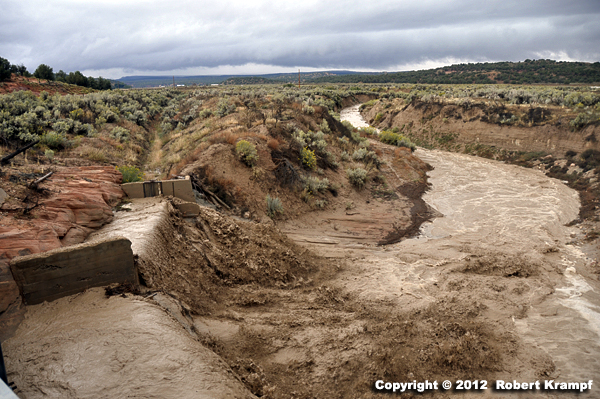
This is Johnson Wash, that runs down the middle of the canyon where we live. It is usually dry, but when it rains up north, we get flash floods. Is this an example of erosion, weathering, both, or neither?
-
Erosion
Yes, the is partially correct! You can tell by the muddy appearance of the water that it is carrying sand, clay and dirt along with it. Erosion is when bits of rock are moved by wind, water, ice, or gravity, so this counts as erosion.. -
Weathering
Yes, the is partially correct! The term "weathering" causes confusion because it sounds like it has something to do with weather. In Earth Science, weathering means "breaking apart." Weathering breaks rocks apart into smaller bits. The fast moving water causes smaller rocks to smash into larger rocks, breaking them apart. -
Both erosion and weathering
Yes! The flash flood in this photo is causing weathering, and erosion. As the flood decreases, and the water slows down, it will drop the sand, clay, dirt, and rocks in a process called deposition. -
Neither erosion nor weathering
No. This flash flood is causing both weathering and erosion.
Click to see which state standards this question tests, and which of my videos, experiments, and other resources support that topic.
Florida
SC.4.E.6.1 Identify the three categories of rocks: igneous, (formed from molten rock); sedimentary (pieces of other rocks and fossilized organisms); and metamorphic (formed from heat and pressure).
| Evaporites | video, learnalong, checked |
| Igneous Rocks and Bubbles | video, free, learnalong, Updated |
| Sedimentary Rocks | video, learnalong |
| What is a Rock? | video, learnalong, checked |
| Bioclastics: Rocks With No Minerals | video |
| Homemade Fossil Dig | text page |
| Foliated and Unfoliated Rocks | text page, learnalong |
| Identifying Igneous Rocks | text page, learnalong |
| Intrusive and Extrusive Igneous Rocks | text page, learnalong |
| Light and Dark Minerals | text page, learnalong |
| Review Rocks-9 | practice |
| Review Rocks-7 | practice |
| Review Rocks-10 | practice |
| Review Rocks-10 | practice |
| Review Rocks-10 | practice |
| Review Rocks-1 | practice |
| Review Rocks-2 | practice |
| Review Rocks-3 | practice |
| Review Rocks-4 | practice |
| Review Rocks-5 | practice |
| Review Rocks-6 | practice |
| Review Rocks-8 | practice |
SC.7.E.6.2 Identify the patterns within the rock cycle and relate them to surface events (weathering and erosion) and sub-surface events (plate tectonics and mountain building).
| Evaporites | video, learnalong, checked |
| What is a Rock? | video, learnalong, checked |
| The Rock Cycle | video, learnalong |
| Change: Fast and Slow | video |
| Erosion | video, checked |
| Continuous Change | video, checked |
| Bioclastics: Rocks With No Minerals | video |
| Weathering and Erosion | video, learnalong, checked |
| Review Rocks-10 | practice |
| Review Rocks-10 | practice |
| Review Rocks-1 | practice |
| Review Erosion-1 | practice |
| Review Erosion-2 | practice |
| Review Erosion-3 | practice |
| Review Erosion-4 | practice |
| Review Erosion-5 | practice |
| Review Rocks-4 | practice |
| Review Rocks-5 | practice |
| Review Rocks-6 | practice |
| Review Rocks-8 | practice |
| Review Rocks-9 | practice |
| Review Rocks-7 | practice |
Utah
UT.4.III.2.b Distinguish between weathering (i.e., wearing down and breaking of rock surfaces) and erosion (i.e., the movement of materials).
| Change: Fast and Slow | video |
| Erosion | video, checked |
| Weathering and Erosion | video, learnalong, checked |
| Review Erosion-1 | practice |
| Review Erosion-2 | practice |
| Review Erosion-3 | practice |
| Review Erosion-4 | practice |
| Review Erosion-5 | practice |
UT.5.II.1.a Identify the objects, processes, or forces that weather and erode Earth’s surface (e.g., ice, plants, animals, abrasion, gravity, water, wind)
| Change: Fast and Slow | video |
| Erosion | video, checked |
| Continuous Change | video, checked |
| Weathering and Erosion | video, learnalong, checked |
| Review Erosion-1 | practice |
| Review Erosion-2 | practice |
| Review Erosion-3 | practice |
| Review Erosion-4 | practice |
| Review Erosion-5 | practice |
UT.8.III.2.b Describe the role of energy in the processes that change rock materials over time.
| Igneous Rocks and Bubbles | video, free, learnalong, Updated |
| Sedimentary Rocks | video, learnalong |
| Change: Fast and Slow | video |
| Erosion | video, checked |
| Continuous Change | video, checked |
| Weathering and Erosion | video, learnalong, checked |
NGSS
4-ESS2-1 Make observations and/or measurements to provide evidence of the effects of weathering or the rate of erosion by water, ice, wind, or vegetation.
| Change: Fast and Slow | video |
| Erosion | video, checked |
| Continuous Change | video, checked |
| Weathering and Erosion | video, learnalong, checked |
| Review Erosion-1 | practice |
| Review Erosion-2 | practice |
| Review Erosion-3 | practice |
| Review Erosion-4 | practice |
| Review Erosion-5 | practice |
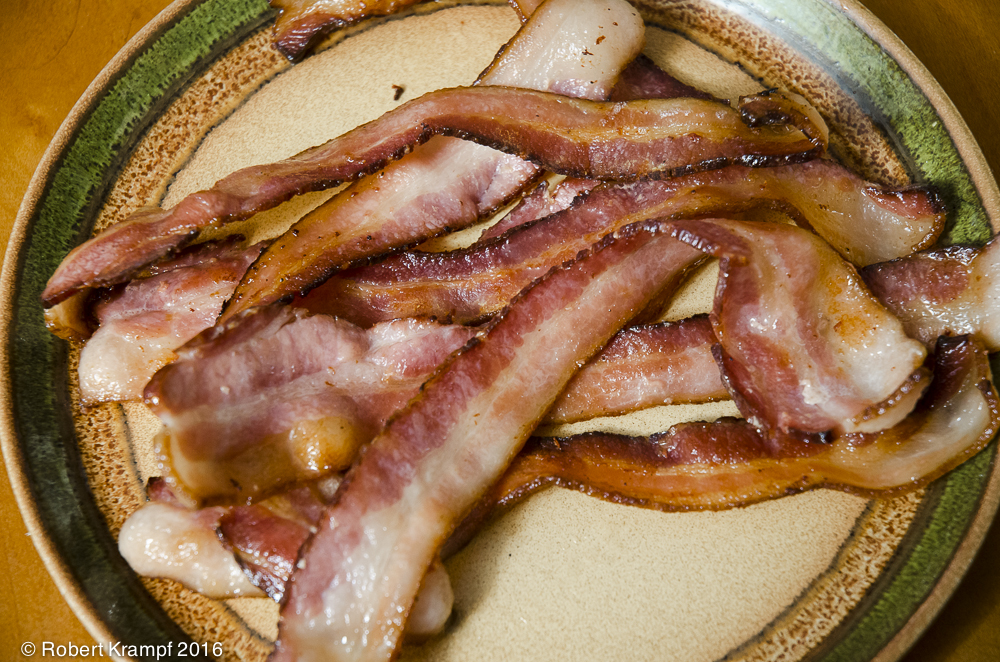
Which organ produces bile to digest the fat in this bacon?
-
Liver
Yes! The liver produces bile, which digests fats. -
Gall Bladder
No. The gall bladder stores the bile, but does not produce it. -
Pancreas
No. The pancreas produces insulin to digest sugar. -
Thyroid
No. The thyroid produces several hormones which control growth and metabolism, but it does not produce bile.
Click to see which state standards this question tests, and which of my videos, experiments, and other resources support that topic.
Florida
SC.2.L.14.1 Distinguish human body parts (brain, heart, lungs, stomach, muscles, and skeleton) and their basic functions.
| Bird Bones | video, free |
| Bendable Bones | video, checked |
| Reading a Skeleton | video, free, checked |
| Review Anatomy-1 | practice |
| Review Anatomy-2 | practice |
| Review Anatomy-3 | practice |
SC.5.L.14.1 Identify the organs in the human body and describe their functions, including the skin, brain, heart, lungs, stomach, liver, intestines, pancreas, muscles and skeleton, reproductive organs, kidneys, bladder, and sensory organs.
| Bird Bones | video, free |
| Kneesy, Earsy, Nosey | video, checked |
| Bendable Bones | video, checked |
| Just a Suggestion | video |
| Reaction Time | video |
| Reading a Skeleton | video, free, checked |
| Muscles Don't Push | text page |
| Review Anatomy-1 | practice |
| Review Anatomy-2 | practice |
| Review Anatomy-3 | practice |
SC.6.L.14.5 Identify and investigate the general functions of the major systems of the human body (digestive, respiratory, circulatory, reproductive, excretory, immune, nervous, and musculoskeletal) and describe ways these systems interact with each other to maintain homeostasis.
| Bird Bones | video, free |
| Bendable Bones | video, checked |
| Reaction Time | video |
| Reading a Skeleton | video, free, checked |
| Muscles Don't Push | text page |
| Review Anatomy-1 | practice |
| Review Anatomy-2 | practice |
| Review Anatomy-3 | practice |
Utah
UT.7.III.2.c Relate the structure of an organ to its component parts and the larger system of which it is a part.
| Reaction Time | video |
| Reading a Skeleton | video, free, checked |
| Review Anatomy-1 | practice |
| Review Anatomy-2 | practice |
| Review Anatomy-3 | practice |
NGSS
MS-LS1-3 Use argument supported by evidence for how the body is a system of interacting subsystems composed of groups of cells.
| Bird Bones | video, free |
| Bendable Bones | video, checked |
| Reaction Time | video |
| Reading a Skeleton | video, free, checked |
| Review Anatomy-1 | practice |
| Review Anatomy-2 | practice |
| Review Anatomy-3 | practice |