
Here are some science questions from the Standards for Grades 2-5 to help you test your knowledge of the Next Generation Sunshine State Standards.
The questions are chosen randomly, so this quest will be different each time you reload the page.
* Click here to see only the most recently added questions.
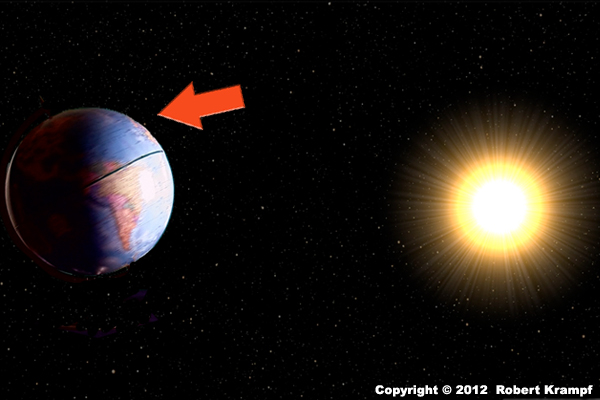
What season is the area that the arrow points to having?
-
Winter
Yes! Even though that area is in daylight, the Earth's axis in that hemisphere is pointing away from the Sun. It gets less direct light, and has shorter days. -
Spring
No. For spring, the Earth's axis for that hemisphere would be in between pointing towards the Sun and away from the Sun. -
Summer
No. Although it is daytime in that area, the Earth's axis in that hemisphere is pointing away from the Sun. It gets less direct light, and has shorter days. -
Autumn
No. For autumn, the Earth's axis for that hemisphere would be in between pointing towards the Sun and away from the Sun.
Click to see which state standards this question tests, and which of my videos, experiments, and other resources support that topic.
Florida
SC.4.E.5.1 Observe that the patterns of stars in the sky stay the same although they appear to shift across the sky nightly, and different stars can be seen in different seasons.
| Global Science | video, ClosedCaptions |
| Review Space-5 | practice |
| Review Space-8 | practice |
| Review Space-12 | practice |
Utah
UT.6.II.2.e Use a model to explain why the seasons are reversed in the Northern and Southern Hemispheres.
| Global Science | video, ClosedCaptions |
| Review Space-5 | practice |
| Review Space-8 | practice |
| Review Space-12 | practice |
NGSS
3-ESS2-1 Represent data in tables and graphical displays to describe typical weather conditions expected during a particular season.
| Nephoscope | video, checked |
| Pine Cone Weather | text page, free |
| Review Weather-5 | practice |
| Review Weather-6 | practice |
| Review Weather-4 | practice |
| Review Weather-3 | practice |
| Review Space-5 | practice |
| Review Space-8 | practice |
5-ESS1-2 Represent data in graphical displays to reveal patterns of daily changes in length and direction of shadows, day and night, and the seasonal appearance of some stars in the night sky.
| Global Science | video, ClosedCaptions |
| Finding Your Way | video, checked |
| Review Space-5 | practice |
| Review Space-8 | practice |
| Review Space-12 | practice |
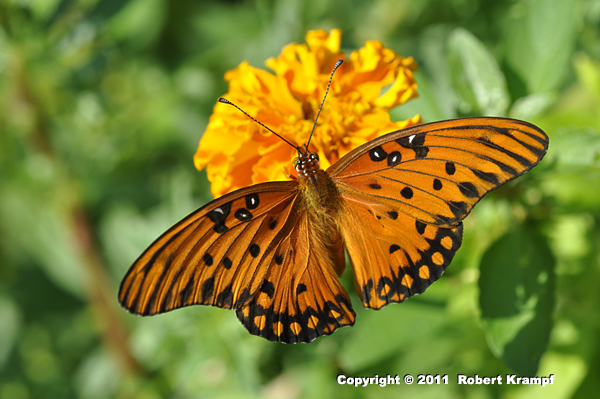
Which of the following observations is NOT scientifically testable?
-
Butterflies have pretty wings.
Yes! Pretty is an opinion, and can vary from person to person, so it is NOT scientifically testable. -
Butterflies have six legs.
No. This could be tested by counting the legs of a variety of butterflies. -
Butterflies can sting like bees.
No. A claim does not have to be true to be testable. Examination of a variety of butterflies would show that they do not have stingers. -
Most butterflies drink nectar from flowers.
No. This could be tested by observing the feeding habits of butterflies.
Explain more about it.
If I said that butterflies did not have six legs, you could show me physical evidence by counting their legs. After counting the legs, the physical evidence would show that butterflies have six legs.
If I said that I don't think butterfly wings are pretty, you could show me wings that you think are pretty, but I might not agree with your opinion. "Pretty" is not something that we can measure. What is pretty to one person might not be pretty to another, so it is not a testable property.
Click to see which state standards this question tests, and which of my videos, experiments, and other resources support that topic.
Florida
SC.5.N.2.1 Recognize and explain that science is grounded in empirical observations that are testable; explanation must always be linked with evidence.
| My Position on Science and Religion | video |
| What is Science?: Objective | video |
| Mobius Strip | video |
| Is Your Project Scientifically Testable? | text page |
| Is Your Project Scientifically Testable? Part 2 | text page |
| Review Scientific Process-3 | practice |
| Review Scientific Process-4 | practice |
| Review Scientific Process-8 | practice |
SC.8.N.2.1 Distinguish between scientific and pseudoscientific ideas.
| What is Science? | video, ClosedCaptions |
| Feeding Bread to Birds | text page |
| Fact checking GMOs | text page |
| I Saw It on the Internet, part four | text page |
| I Saw It on the Internet, part three | text page |
| I Saw It on the Internet, part two | text page |
| I Saw It on the Internet, part one | text page |
| Review Scientific Process-3 | practice |
| Review Scientific Process-4 | practice |
| Review Scientific Process-8 | practice |
Utah
NGSS
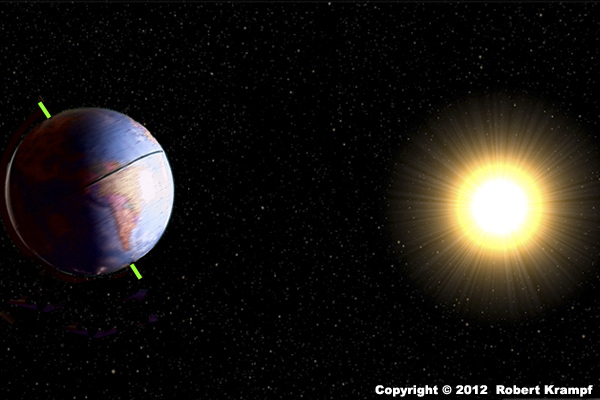
It takes the Earth 24 hours to:
-
Rotate
Yes. The Earth turns on its axis to make one full rotation every 24 hours. -
Revolve
No. It takes a year for the Earth to revolve around the Sun. -
Orbit
No. It takes a year for the Earth to orbit around the Sun. -
Reverse
No. The motion of the Earth does not reverse.
Click to see which state standards this question tests, and which of my videos, experiments, and other resources support that topic.
Florida
SC.4.E.5.3 Recognize that Earth revolves around the Sun in a year and rotates on its axis in a 24-hour day.
| Making a Scale Model of the Solar System | video, ClosedCaptions |
| Global Science | video, ClosedCaptions |
| Finding Your Way | video, checked |
| Review Space-11 | practice |
SC.8.E.5.7 Compare and contrast the properties of objects in the Solar System including the Sun, planets, and moons to those of Earth, such as gravitational force, distance from the Sun, speed, movement, temperature, and atmospheric conditions.
| Making a Scale Model of the Solar System | video, ClosedCaptions |
| Global Science | video, ClosedCaptions |
| Planets and Pennies | video, ClosedCaptions |
| Review Space-4 | practice |
| Review Space-11 | practice |
Utah
UT.3.I.2.a Describe the motions of Earth (i.e., the rotation [spinning] of Earth on its axis, the revolution [orbit] of Earth around the sun).
| Global Science | video, ClosedCaptions |
| Review Space-11 | practice |
UT.6.I.2.a Identify the difference between the motion of an object rotating on its axis and an object revolving in orbit.
| Review Space-11 | practice |
NGSS
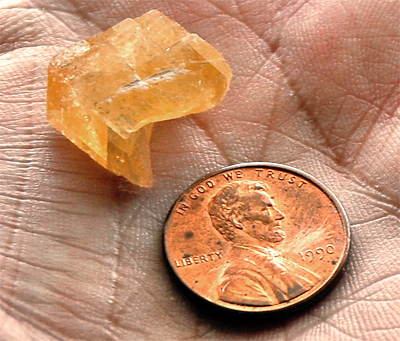
I used this piece of calcite to scratch this penny. Then I used the penny to scratch the piece of calcite. What does that tell us?
-
It tells us that I did the test wrong.
No. The test was done correctly. -
It tells us that they both have the same hardness.
Yes! You test the hardness of a mineral by testing to see what will scratch it. If two substances scratch each other, they have the same hardness. -
It tells us that calcite is not a mineral.
No. Scratching a specimen will not tell you if it is a mineral. -
It tells us that calcite has cleavage.
No. You do not test for cleavage by scratching a mineral.
Click to see which state standards this question tests, and which of my videos, experiments, and other resources support that topic.
Florida
SC.4.E.6.2 Identify the physical properties of common earth-forming minerals, including hardness, color, luster, cleavage, and streak color, and recognize the role of minerals in the formation of rocks.
| What is a Mineral? | video, checked |
| Identifying Minerals | video, learnalong |
| Definition of a Mineral | video, checked |
| Minerals Around You | text page, learnalong, checked |
| Review Minerals-1 | practice |
| Review Minerals-2 | practice |
| Review Minerals-3 | practice |
| Review Minerals-4 | practice |
| Review Minerals-5 | practice |
| Review Minerals-6 | practice |
| Review Minerals-7 | practice |
| Review Minerals-8 | practice |
Utah
UT.4.III.1.b Observe rocks using a magnifying glass and draw shapes and colors of the minerals.
| What is a Mineral? | video, checked |
| Identifying Minerals | video, learnalong |
| What is a Rock? | video, learnalong, checked |
| Definition of a Mineral | video, checked |
| Review Minerals-3 | practice |
| Review Minerals-4 | practice |
| Review Minerals-5 | practice |
| Review Minerals-6 | practice |
| Review Minerals-7 | practice |
| Review Minerals-8 | practice |
UT.8.III.1.b Observe and describe the minerals found in rocks (e.g., shape, color, luster, texture, hardness).
| What is a Mineral? | video, checked |
| Identifying Minerals | video, learnalong |
| What is a Rock? | video, learnalong, checked |
| Definition of a Mineral | video, checked |
| Review Minerals-1 | practice |
| Review Minerals-2 | practice |
| Review Minerals-3 | practice |
| Review Minerals-4 | practice |
| Review Minerals-5 | practice |
| Review Minerals-6 | practice |
| Review Minerals-7 | practice |
| Review Minerals-8 | practice |
NGSS
5-PS1-3 Make observations and measurements to identify materials based on their properties.
| Raw Egg or Boiled? | video, checked |
| Making Turmeric Paper | video, checked |
| Testing for Tannic Acid | video |
| Definition of a Mineral | video, checked |
| Floating Bubbles | video, checked |
| Finding Fat in Foods | video, ClosedCaptions, checked |
| Fireworks Colors | video |
| Iron Cereal | video, ClosedCaptions, checked |
| Density: Ice, Oil, and Water | video, checked |
| Wax and Wood, part 1 | video, checked |
| Wax and Wood, part 2 | video, checked |
| What is a Mineral? | video, checked |
| Identifying Minerals | video, learnalong |
| A Cool Change | text page |
| Acid Hunt | text page |
| Review Minerals-2 | practice |
| Review Minerals-3 | practice |
| Review Minerals-4 | practice |
| Review Minerals-5 | practice |
| Review Minerals-6 | practice |
| Review Minerals-7 | practice |
| Review Minerals-8 | practice |
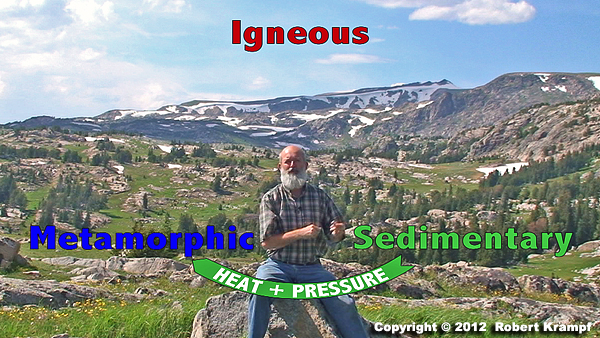
As we look at the rock cycle, we can see that heat and pressure can change a sedimentary rock into a metamorphic rock. What would change a metamorphic rock into a sedimentary rock?
-
More heat and pressure
No. More heat and pressure would cause more metamorphic change. -
Erosion and deposition
Yes. If the rock was eroded and deposited, that would form a sedimentary rock. -
Melting and cooling
No. Melting the rock and then cooling it would produce an igneous rock. -
A metamorphic rock cannot become a sedimentary rock
No. In the rock cycle, a rock from any group (igneous, sedimentary, metamorphic) can be changed into a rock from any group.
Click to see which state standards this question tests, and which of my videos, experiments, and other resources support that topic.
Florida
SC.4.E.6.1 Identify the three categories of rocks: igneous, (formed from molten rock); sedimentary (pieces of other rocks and fossilized organisms); and metamorphic (formed from heat and pressure).
| Evaporites | video, learnalong, checked |
| Igneous Rocks and Bubbles | video, free, learnalong, Updated |
| Sedimentary Rocks | video, learnalong |
| What is a Rock? | video, learnalong, checked |
| Bioclastics: Rocks With No Minerals | video |
| Light and Dark Minerals | text page, learnalong |
| Homemade Fossil Dig | text page |
| Foliated and Unfoliated Rocks | text page, learnalong |
| Identifying Igneous Rocks | text page, learnalong |
| Intrusive and Extrusive Igneous Rocks | text page, learnalong |
| Review Rocks-2 | practice |
| Review Rocks-3 | practice |
| Review Rocks-4 | practice |
| Review Rocks-5 | practice |
| Review Rocks-6 | practice |
| Review Rocks-8 | practice |
| Review Rocks-9 | practice |
| Review Rocks-7 | practice |
| Review Rocks-10 | practice |
| Review Rocks-10 | practice |
| Review Rocks-10 | practice |
| Review Rocks-1 | practice |
SC.7.E.6.2 Identify the patterns within the rock cycle and relate them to surface events (weathering and erosion) and sub-surface events (plate tectonics and mountain building).
| Evaporites | video, learnalong, checked |
| What is a Rock? | video, learnalong, checked |
| The Rock Cycle | video, learnalong |
| Change: Fast and Slow | video |
| Erosion | video, checked |
| Continuous Change | video, checked |
| Bioclastics: Rocks With No Minerals | video |
| Weathering and Erosion | video, learnalong, checked |
| Review Erosion-4 | practice |
| Review Erosion-5 | practice |
| Review Rocks-4 | practice |
| Review Rocks-5 | practice |
| Review Rocks-6 | practice |
| Review Rocks-8 | practice |
| Review Rocks-9 | practice |
| Review Rocks-7 | practice |
| Review Rocks-10 | practice |
| Review Rocks-10 | practice |
| Review Rocks-1 | practice |
| Review Erosion-1 | practice |
| Review Erosion-2 | practice |
| Review Erosion-3 | practice |
Utah
UT.4.III.1.a Describe the differences between minerals and rocks.
| What is a Mineral? | video, checked |
| Identifying Minerals | video, learnalong |
| What is a Rock? | video, learnalong, checked |
| Bioclastics: Rocks With No Minerals | video |
| Definition of a Mineral | video, checked |
| Review Rocks-1 | practice |
| Review Rocks-4 | practice |
| Review Rocks-5 | practice |
| Review Rocks-6 | practice |
| Review Rocks-8 | practice |
| Review Rocks-9 | practice |
| Review Rocks-7 | practice |
| Review Rocks-10 | practice |
NGSS
4-ESS1-1 Identify evidence from patterns in rock formations and fossils in rock layers to support an explanation for changes in a landscape over time.
| Evaporites | video, learnalong, checked |
| Igneous Rocks and Bubbles | video, free, learnalong, Updated |
| Sedimentary Rocks | video, learnalong |
| Reading the Rocks: Law of Superposition | video |
| Reading the Rocks: Law of Crosscutting | video |
| What is a Rock? | video, learnalong, checked |
| Reading the Rocks: The Present is the Key to the Past | video, ClosedCaptions |
| Paleo Cookies | video |
| Homemade Fossil Dig | text page |
| Review Geologic Time-2 | practice |
| Review Rocks-5 | practice |
| Review Rocks-6 | practice |
| Review Rocks-8 | practice |
| Review Rocks-9 | practice |
| Review Rocks-7 | practice |
| Review Rocks-10 | practice |
| Review Geologic Time-3 | practice |
| Review Rocks-1 | practice |
| Review Geologic Time-1 | practice |
| Review Rocks-4 | practice |
MS-ESS2-1 Develop a model to describe the cycling of Earth’s materials and the flow of energy that drives this process.
| Evaporites | video, learnalong, checked |
| Definition of a Mineral | video, checked |
| Igneous Rocks and Bubbles | video, free, learnalong, Updated |
| What is a Mineral? | video, checked |
| Identifying Minerals | video, learnalong |
| Sedimentary Rocks | video, learnalong |
| What is a Rock? | video, learnalong, checked |
| The Rock Cycle | video, learnalong |
| Bioclastics: Rocks With No Minerals | video |
| Light and Dark Minerals | text page, learnalong |
| Review Rocks-2 | practice |
| Review Rocks-3 | practice |
| Review Rocks-4 | practice |
| Review Rocks-5 | practice |
| Review Rocks-6 | practice |
| Review Rocks-8 | practice |
| Review Rocks-9 | practice |
| Review Rocks-7 | practice |
| Review Rocks-10 | practice |
| Review Rocks-10 | practice |
| Review Rocks-10 | practice |
| Review Rocks-1 | practice |