
Here are some science questions to help you test your general science knowledge. They will also show you which of the Florida, Utah, and NGSS science standards each question is testing.
The questions are chosen randomly, so this quest will be different each time.
Get 5 more random questions.
Would you rather see the most recently added questions?
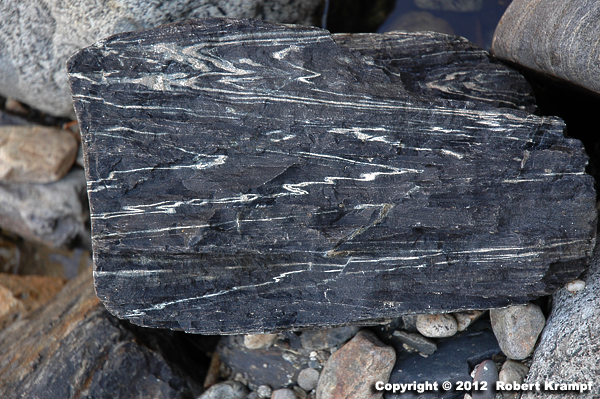
The white lines in this piece of rock were straight when the formed. Later, the rock was squeezed by tremendous pressure that compressed the layers into squiggles. What kind of rock is it?.
-
Igneous
No. Igneous rocks formed from magma or lava. The original rock was igneous, but it has been changed and is no long an igneous rock. -
Sedimentary
No. Sedimentary rocks are bits of other rocks that have been moved and deposited. This rock was squeezed, not moved and deposited. It is not sedimentary. -
Metamorphic
Yes! Rocks that are changed by pressure and/or heat are classified as metamorphic rocks. The wavy, white lines show us that the rock has been squeezed by tremendous pressure. That tells us it is a metamorphic rock. -
None of the above.
No. All rocks are classified as either igneous, sedimentary, or metamorphic.
Click to see which state standards this question tests, and which of my videos, experiments, and other resources support that topic.
Florida
SC.4.E.6.1 Identify the three categories of rocks: igneous, (formed from molten rock); sedimentary (pieces of other rocks and fossilized organisms); and metamorphic (formed from heat and pressure).
| Evaporites | video, learnalong, checked |
| Igneous Rocks and Bubbles | video, free, learnalong, Updated |
| Sedimentary Rocks | video, learnalong |
| What is a Rock? | video, learnalong, checked |
| Bioclastics: Rocks With No Minerals | video |
| Foliated and Unfoliated Rocks | text page, learnalong |
| Identifying Igneous Rocks | text page, learnalong |
| Intrusive and Extrusive Igneous Rocks | text page, learnalong |
| Light and Dark Minerals | text page, learnalong |
| Homemade Fossil Dig | text page |
| Review Rocks-2 | practice |
| Review Rocks-3 | practice |
| Review Rocks-4 | practice |
| Review Rocks-5 | practice |
| Review Rocks-6 | practice |
| Review Rocks-8 | practice |
| Review Rocks-9 | practice |
| Review Rocks-7 | practice |
| Review Rocks-10 | practice |
| Review Rocks-10 | practice |
| Review Rocks-10 | practice |
| Review Rocks-1 | practice |
SC.7.E.6.2 Identify the patterns within the rock cycle and relate them to surface events (weathering and erosion) and sub-surface events (plate tectonics and mountain building).
| Bioclastics: Rocks With No Minerals | video |
| Weathering and Erosion | video, learnalong, checked |
| Evaporites | video, learnalong, checked |
| What is a Rock? | video, learnalong, checked |
| The Rock Cycle | video, learnalong |
| Change: Fast and Slow | video |
| Erosion | video, checked |
| Continuous Change | video, checked |
| Review Erosion-2 | practice |
| Review Erosion-3 | practice |
| Review Erosion-4 | practice |
| Review Erosion-5 | practice |
| Review Rocks-4 | practice |
| Review Rocks-5 | practice |
| Review Rocks-6 | practice |
| Review Rocks-8 | practice |
| Review Rocks-9 | practice |
| Review Rocks-7 | practice |
| Review Rocks-10 | practice |
| Review Rocks-10 | practice |
| Review Rocks-1 | practice |
| Review Erosion-1 | practice |
Utah
UT.4.III.1.c Sort rocks by appearance according to the three basic types: sedimentary, igneous and metamorphic (e.g., sedimentary–rounded-appearing mineral and rock particles that are cemented together, often in layers; igneous–with or without observable crystals that are not in layers or with or without air holes or glasslike; metamorphic –crystals/minerals, often in layers).
| Igneous Rocks and Bubbles | video, free, learnalong, Updated |
| What is a Mineral? | video, checked |
| Identifying Minerals | video, learnalong |
| Sedimentary Rocks | video, learnalong |
| What is a Rock? | video, learnalong, checked |
| Definition of a Mineral | video, checked |
| Review Rocks-10 | practice |
UT.4.III.1.d Classify common rocks found in Utah as sedimentary (i.e., sandstone, conglomerate, shale), igneous (i.e., basalt, granite, obsidian, pumice) and metamorphic (i.e., marble, gneiss, schist).
| Evaporites | video, learnalong, checked |
| Igneous Rocks and Bubbles | video, free, learnalong, Updated |
| Sedimentary Rocks | video, learnalong |
| What is a Rock? | video, learnalong, checked |
| Light and Dark Minerals | text page, learnalong |
| Review Rocks-2 | practice |
| Review Rocks-3 | practice |
| Review Rocks-10 | practice |
| Review Rocks-10 | practice |
NGSS
MS-ESS2-1 Develop a model to describe the cycling of Earth’s materials and the flow of energy that drives this process.
| The Rock Cycle | video, learnalong |
| Bioclastics: Rocks With No Minerals | video |
| Evaporites | video, learnalong, checked |
| Definition of a Mineral | video, checked |
| Igneous Rocks and Bubbles | video, free, learnalong, Updated |
| What is a Mineral? | video, checked |
| Identifying Minerals | video, learnalong |
| Sedimentary Rocks | video, learnalong |
| What is a Rock? | video, learnalong, checked |
| Light and Dark Minerals | text page, learnalong |
| Review Rocks-1 | practice |
| Review Rocks-2 | practice |
| Review Rocks-3 | practice |
| Review Rocks-4 | practice |
| Review Rocks-5 | practice |
| Review Rocks-6 | practice |
| Review Rocks-8 | practice |
| Review Rocks-9 | practice |
| Review Rocks-7 | practice |
| Review Rocks-10 | practice |
| Review Rocks-10 | practice |
| Review Rocks-10 | practice |
MS-ESS2-1 Develop a model to describe the cycling of Earth’s materials and the flow of energy that drives this process.
| The Rock Cycle | video, learnalong |
| Bioclastics: Rocks With No Minerals | video |
| Evaporites | video, learnalong, checked |
| Definition of a Mineral | video, checked |
| Igneous Rocks and Bubbles | video, free, learnalong, Updated |
| What is a Mineral? | video, checked |
| Identifying Minerals | video, learnalong |
| Sedimentary Rocks | video, learnalong |
| What is a Rock? | video, learnalong, checked |
| Light and Dark Minerals | text page, learnalong |
| Review Rocks-1 | practice |
| Review Rocks-2 | practice |
| Review Rocks-3 | practice |
| Review Rocks-4 | practice |
| Review Rocks-5 | practice |
| Review Rocks-6 | practice |
| Review Rocks-8 | practice |
| Review Rocks-9 | practice |
| Review Rocks-7 | practice |
| Review Rocks-10 | practice |
| Review Rocks-10 | practice |
| Review Rocks-10 | practice |
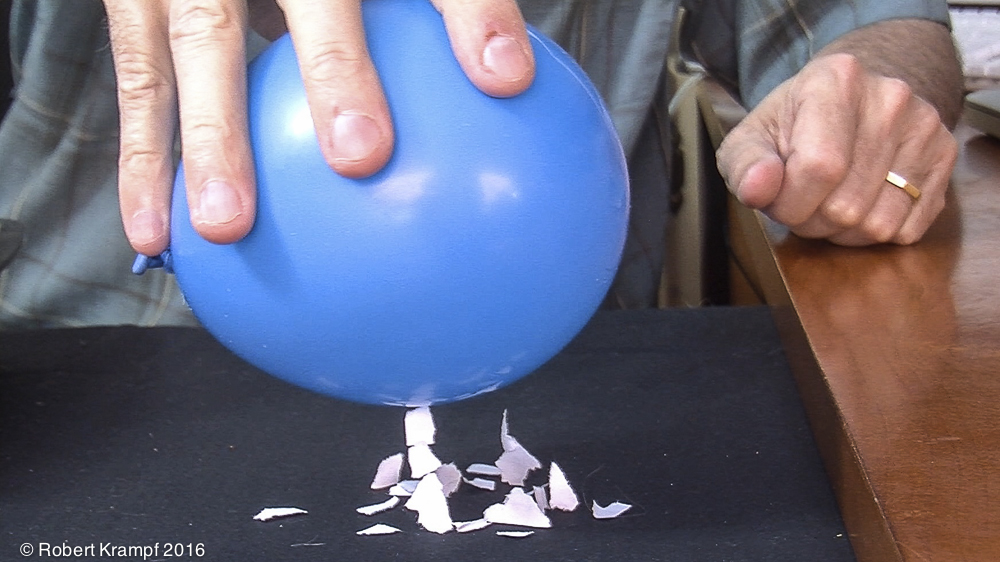
I gave this balloon a negative electrostatic charge by rubbing it on my hair. Then I tore up bits of paper, and put them on the table. When I brought the balloon near them, they were attracted to the balloon. Why?
-
The negative charge of the balloon induced a positive charge on the paper.
Yes! The negative charge on the balloon pushes some of the negatively charged electrons in the paper to the far side, leaving the near side with a positive charge. Opposite charges attract, so the paper is attracted to the balloon. -
The negative charge of the balloon attracts the neutrally charged paper.
No. As long as the paper is neutral, it will not be attracted or repelled. -
Tearing the paper gave it a positive charge.
No. If the paper had a positive charge from being torn, the bits of paper with like charges would have repelled each other before you moved the balloon nearby. -
Paper is always attracted to balloons.
No. This is easily tested by using a balloon that has not been rubbed on your hair. Without the positive charge, the paper is not attracted.
Click to see which state standards this question tests, and which of my videos, experiments, and other resources support that topic.
Florida
SC.5.P.10.3 Investigate and explain that an electrically-charged object can attract an uncharged object and can either attract or repel another charged object without any contact between the objects.
>>> Teacher Page: Electrostatic Charges
| Challenge: Paper, Coin, Cup, part 1 | video |
| Electrostatic Charges | video |
| The Leyden Jar | video, checked |
| Versorium | video, checked |
| Electrostatics and Water | video, ClosedCaptions, checked |
| Challenge: Paper, Coin, Cup, part 2 | video |
| Sorting Salt and Pepper | video, checked |
| Electricity | video, free, Updated |
| Making Water Wiggle | video |
| Review Energy-6 | quest |
| Review Energy-7 | quest |
| Review Energy-8 | quest |
SC.6.P.13.1 Investigate and describe types of forces including contact forces and forces acting at a distance, such as electrical, magnetic, and gravitational.
| Challenge: Paper, Coin, Cup, part 1 | video |
| Making a Compass | video, checked |
| Torque | video |
| Versorium | video, checked |
| Water in a Glass, part 2 | video, checked |
| Water in a Glass, part 3 | video, checked |
| Water in a Glass, part 1 | video, checked |
| Challenge: Paper, Coin, Cup, part 2 | video |
| Light a Bulb with a Balloon | video, checked |
| Crushed Can | video, checked |
| Electricity | video, free, Updated |
| The Compass and Magnetic Fields | video, ClosedCaptions, checked |
| Review Energy-6 | quest |
| Review Energy-7 | quest |
| Review Energy-8 | quest |
Utah
UT.5.IV.1.c Describe the behavior of objects charged with static electricity in attracting or repelling without touching.
| Challenge: Paper, Coin, Cup, part 1 | video |
| Electrostatic Charges | video |
| The Leyden Jar | video, checked |
| Versorium | video, checked |
| Electrostatics and Water | video, ClosedCaptions, checked |
| Challenge: Paper, Coin, Cup, part 2 | video |
| Sorting Salt and Pepper | video, checked |
| Making Water Wiggle | video |
| Review Energy-6 | quest |
| Review Energy-7 | quest |
NGSS
MS-PS3-2 Develop a model to describe that when the arrangement of objects interacting at a distance changes, different amounts of potential energy are stored in the system.
| Measuring Kinetic and Potential Energy | video, checked |
| Challenge: Paper, Coin, Cup, part 1 | video |
| The Leyden Jar | video, checked |
| Versorium | video, checked |
| Water in a Glass, part 2 | video, checked |
| Water in a Glass, part 3 | video, checked |
| Water in a Glass, part 1 | video, checked |
| Electrostatics and Water | video, ClosedCaptions, checked |
| Challenge: Paper, Coin, Cup, part 2 | video |
| Sorting Salt and Pepper | video, checked |
| Making Water Wiggle | video |
| Review Energy-6 | quest |
| Review Energy-7 | quest |
| Review Energy-8 | quest |
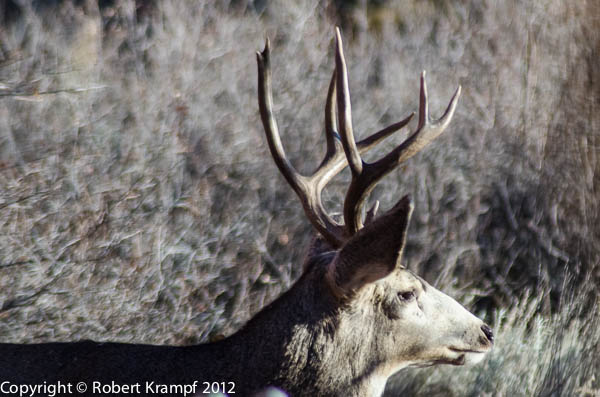
Notice that the very back point on this Mule Deer's antlers is split. This is a genetic trait which is becoming more and more common because hunters would rather shoot deer with perfect antlers. This is an example of:
-
why hunting deer is a bad idea.
No. Actually, deer hunting is very important. Because we have killed off many of their natural predators, if hunters did not control their population, large numbers of them would starve to death. -
an adaptation that improves an organism's chance for survival.
Yes. Because hunters are less likely to shoot it, this deer is more likely to survive long enough to reproduce, passing this trait on to its offspring. -
an acquired trait.
No. This is a genetic trait, not an acquired trait. -
why antlers are more useful than horns.
No. Antlers and horns serve different functions, but both are useful to the animal that has them.
Click to see which state standards this question tests, and which of my videos, experiments, and other resources support that topic.
Florida
SC.5.L.15.1 Describe how, when the environment changes, differences between individuals allow some plants and animals to survive and reproduce while others die or move to new locations.
| Who Evolved on First? | text page, free, checked |
| Review Adaptation-1 | practice |
| Review Adaptation-5 | practice |
| Review Adaptation-6 | practice |
SC.7.L.15.2 Explore the scientific theory of evolution by recognizing and explaining ways in which genetic variation and environmental factors contribute to evolution by natural selection and diversity of organisms.
| Who Evolved on First? | text page, free, checked |
| Review Adaptation-1 | practice |
Utah
UT.5.V.2.c Describe how a particular physical attribute may provide an advantage for survival in one environment but not in another (e.g., heavy fur in arctic climates keep animals warm whereas in hot desert climates it would cause overheating; flippers on such animals as sea lions and seals provide excellent swimming structures in the water but become clumsy and awkward on land; cacti retain the right amount of water in arid regions but would develop root rot in a more temperate region; fish gills have the ability to absorb oxygen in water but not on land).
| Review Adaptation-1 | practice |
| Review Adaptation-5 | practice |
| Review Adaptation-6 | practice |
UT.7.IV.2.a Predict why certain traits (e.g., structure of teeth, body structure, coloration) are more likely to offer an advantage for survival of an organism.
| Selective Smelling | video, checked |
| Onion Crystals | video |
| Who Evolved on First? | text page, free, checked |
| Thoughts on an Exoskeleton | text page, free |
| Review Adaptation-1 | practice |
| Review Adaptation-2 | practice |
| Review Adaptation-5 | practice |
| Review Adaptation-6 | practice |
NGSS
3-LS4-2 Use evidence to construct an explanation for how the variations in characteristics among individuals of the same species may provide advantages in surviving, finding mates, and reproducing.
| Flowers | video, ClosedCaptions |
| Who Evolved on First? | text page, free, checked |
| Review Adaptation-1 | practice |
| Review Adaptation-3 | practice |
| Review Adaptation-4 | practice |
| Review Adaptation-5 | practice |
| Review Adaptation-6 | practice |
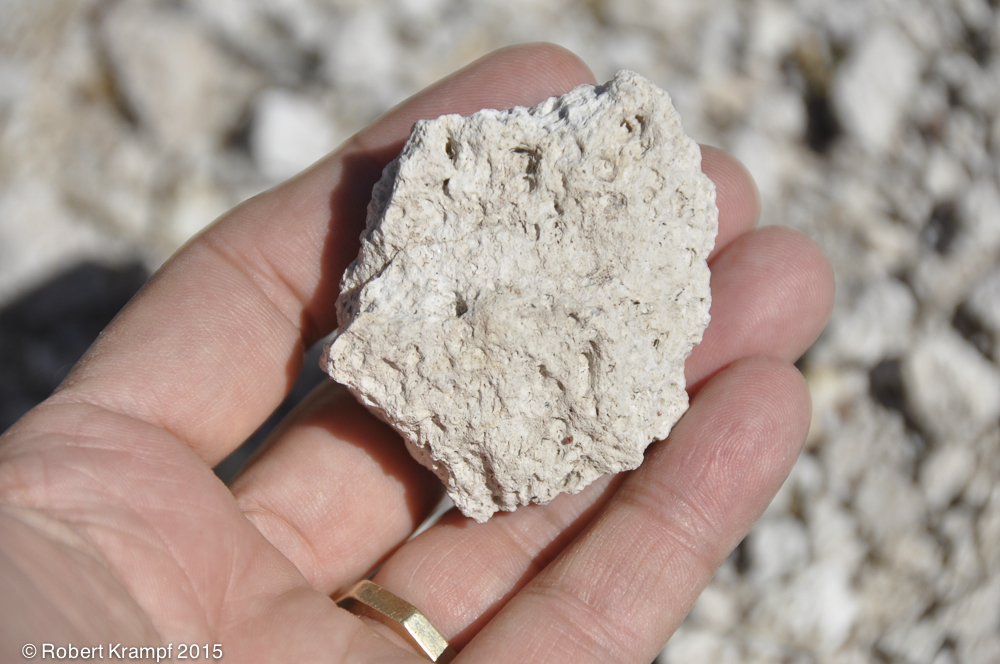
This is called Pumice. It is formed when magma reaches the surface, and reduced pressure lets gas bubbles escape. When it cools, it has so many trapped air bubbles that it will actually float in water. What kind of rock is it?.
-
Igneous
Yes! Igneous rocks formed from magma or lava. This is an igneous rock. -
Sedimentary
No. Sedimentary rocks are deposited by wind, water, ice, or gravity, and they often contain fossils. This is not a sedimentary rock. -
Metamorphic
No. Metamorphic rocks have been changed by heat and pressure from a different kind of rock. Instead of being changed, this got hot enough to completely melt, so it is not metamorphic. -
Pumice is not a rock.
No. Pumice is a naturally occurring solid that forms large layers in the Earth. Pumice is a rock.
Click to see which state standards this question tests, and which of my videos, experiments, and other resources support that topic.
Florida
SC.4.E.6.1 Identify the three categories of rocks: igneous, (formed from molten rock); sedimentary (pieces of other rocks and fossilized organisms); and metamorphic (formed from heat and pressure).
| Evaporites | video, learnalong, checked |
| Igneous Rocks and Bubbles | video, free, learnalong, Updated |
| Sedimentary Rocks | video, learnalong |
| What is a Rock? | video, learnalong, checked |
| Bioclastics: Rocks With No Minerals | video |
| Foliated and Unfoliated Rocks | text page, learnalong |
| Identifying Igneous Rocks | text page, learnalong |
| Intrusive and Extrusive Igneous Rocks | text page, learnalong |
| Light and Dark Minerals | text page, learnalong |
| Homemade Fossil Dig | text page |
| Review Rocks-2 | practice |
| Review Rocks-3 | practice |
| Review Rocks-4 | practice |
| Review Rocks-5 | practice |
| Review Rocks-6 | practice |
| Review Rocks-8 | practice |
| Review Rocks-9 | practice |
| Review Rocks-7 | practice |
| Review Rocks-10 | practice |
| Review Rocks-10 | practice |
| Review Rocks-10 | practice |
| Review Rocks-1 | practice |
SC.7.E.6.2 Identify the patterns within the rock cycle and relate them to surface events (weathering and erosion) and sub-surface events (plate tectonics and mountain building).
| Bioclastics: Rocks With No Minerals | video |
| Weathering and Erosion | video, learnalong, checked |
| Evaporites | video, learnalong, checked |
| What is a Rock? | video, learnalong, checked |
| The Rock Cycle | video, learnalong |
| Change: Fast and Slow | video |
| Erosion | video, checked |
| Continuous Change | video, checked |
| Review Erosion-2 | practice |
| Review Erosion-3 | practice |
| Review Erosion-4 | practice |
| Review Erosion-5 | practice |
| Review Rocks-4 | practice |
| Review Rocks-5 | practice |
| Review Rocks-6 | practice |
| Review Rocks-8 | practice |
| Review Rocks-9 | practice |
| Review Rocks-7 | practice |
| Review Rocks-10 | practice |
| Review Rocks-10 | practice |
| Review Rocks-1 | practice |
| Review Erosion-1 | practice |
Utah
UT.4.III.1.a Describe the differences between minerals and rocks.
| Definition of a Mineral | video, checked |
| What is a Mineral? | video, checked |
| Identifying Minerals | video, learnalong |
| What is a Rock? | video, learnalong, checked |
| Bioclastics: Rocks With No Minerals | video |
| Review Rocks-10 | practice |
| Review Rocks-1 | practice |
| Review Rocks-4 | practice |
| Review Rocks-5 | practice |
| Review Rocks-6 | practice |
| Review Rocks-8 | practice |
| Review Rocks-9 | practice |
| Review Rocks-7 | practice |
NGSS
4-ESS1-1 Identify evidence from patterns in rock formations and fossils in rock layers to support an explanation for changes in a landscape over time.
| Reading the Rocks: The Present is the Key to the Past | video, ClosedCaptions |
| Paleo Cookies | video |
| Evaporites | video, learnalong, checked |
| Igneous Rocks and Bubbles | video, free, learnalong, Updated |
| Sedimentary Rocks | video, learnalong |
| Reading the Rocks: Law of Superposition | video |
| Reading the Rocks: Law of Crosscutting | video |
| What is a Rock? | video, learnalong, checked |
| Homemade Fossil Dig | text page |
| Review Rocks-1 | practice |
| Review Geologic Time-1 | practice |
| Review Rocks-4 | practice |
| Review Geologic Time-2 | practice |
| Review Rocks-5 | practice |
| Review Rocks-6 | practice |
| Review Rocks-8 | practice |
| Review Rocks-9 | practice |
| Review Rocks-7 | practice |
| Review Rocks-10 | practice |
| Review Geologic Time-3 | practice |
MS-ESS2-1 Develop a model to describe the cycling of Earth’s materials and the flow of energy that drives this process.
| The Rock Cycle | video, learnalong |
| Bioclastics: Rocks With No Minerals | video |
| Evaporites | video, learnalong, checked |
| Definition of a Mineral | video, checked |
| Igneous Rocks and Bubbles | video, free, learnalong, Updated |
| What is a Mineral? | video, checked |
| Identifying Minerals | video, learnalong |
| Sedimentary Rocks | video, learnalong |
| What is a Rock? | video, learnalong, checked |
| Light and Dark Minerals | text page, learnalong |
| Review Rocks-1 | practice |
| Review Rocks-2 | practice |
| Review Rocks-3 | practice |
| Review Rocks-4 | practice |
| Review Rocks-5 | practice |
| Review Rocks-6 | practice |
| Review Rocks-8 | practice |
| Review Rocks-9 | practice |
| Review Rocks-7 | practice |
| Review Rocks-10 | practice |
| Review Rocks-10 | practice |
| Review Rocks-10 | practice |
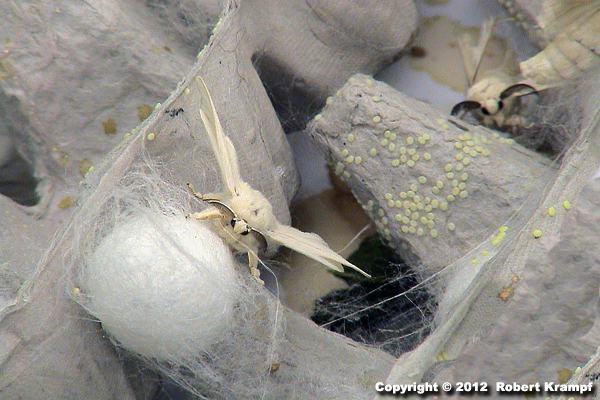
This photograph shows three stages of the life cycle of a silk moth. Which stage is NOT shown?
-
Egg
No. The light yellow dots are silk moth eggs. -
Larva
Yes! There are not silk moth caterpillars in the picture. -
Pupa
No. The white, fuzzy ball beside the moth is the cocoon, which contains the pupa. -
Adult
No. The white moth is an adult silk moth.
Click to see which state standards this question tests, and which of my videos, experiments, and other resources support that topic.
Florida
SC.2.L.16.1 Observe and describe major stages in the life cycles of plants and animals, including beans and butterflies.
| Seed Search | video, ClosedCaptions, checked |
| Review Life Cycle-1 | practice |
| Review Life Cycle-2 | practice |
| Review Life Cycle-3 | practice |
| Review Life Cycle-4 | practice |
SC.4.L.16.4 Compare and contrast the major stages in the life cycles of Florida plants and animals, such as those that undergo incomplete and complete metamorphosis, and flowering and nonflowering seedbearing
plants.
| Orange Slices | video, ClosedCaptions |
| Creating a Sprout Guide | text page, photography, free |
| Review Life Cycle-1 | practice |
| Review Life Cycle-2 | practice |
| Review Plants-4 | practice |
| Review Life Cycle-3 | practice |
| Review Life Cycle-4 | practice |
Utah
UT.5.V.1.c Compare various examples of offspring that do not initially resemble the parent organism but mature to become similar to the parent organism (e.g., mealworms and darkling beetles, tadpoles and frogs, seedlings and vegetables, caterpillars and butterflies).
| Review Life Cycle-1 | practice |
| Review Life Cycle-2 | practice |
| Review Life Cycle-3 | practice |
| Review Life Cycle-4 | practice |
NGSS
1-LS3-1 Make observations to construct an evidence-based account that young plants and animals are like, but not exactly like, their parents.
| Review Life Cycle-1 | practice |
| Review Life Cycle-2 | practice |
| Review Life Cycle-3 | practice |
3-LS1-1 Develop models to describe that organisms have unique and diverse life cycles but all have in common birth, growth, reproduction, and death.
| Review Life Cycle-1 | practice |
| Review Life Cycle-2 | practice |
| Review Life Cycle-3 | practice |
The questions are chosen randomly, so this quest will be different each time.